Author Information
About the Journal
RUAS (Review of Urbanism and Architectural Studies) is a scientific publication for widespread research and criticism on topics related to urbanism and architectural studies. This journal publishes articles that cover textual and fieldwork studies with various perspectives of urbanism and architectural studies.
Journal title : Review of Urbanism and Architectural Studies
Abbreviation : RUAS
Website: ruas.ub.ac.id
ISSN : 2477-6033 (e) 2338-1701 (p)
DOI Prefix : 10.21776/ub.ruas
Type of peer-review : Double Blind
Indexing : see here
Frequency : twice a year (No 1: June-November, and No 2: December-May)
Editors: see Editorial Team
Journal cover: get here
In collaboration with Ikatan Arsitek Indonesia Wilayah Malang (IAI Malang), Ikatan Peneliti Lingkungan Binaan (IPLBI), and Asosiasi Pendidikan Tinggi Arsitektur Indonesia (APTARI).
Current Issue
Vol. 24 No. 1 (2026)
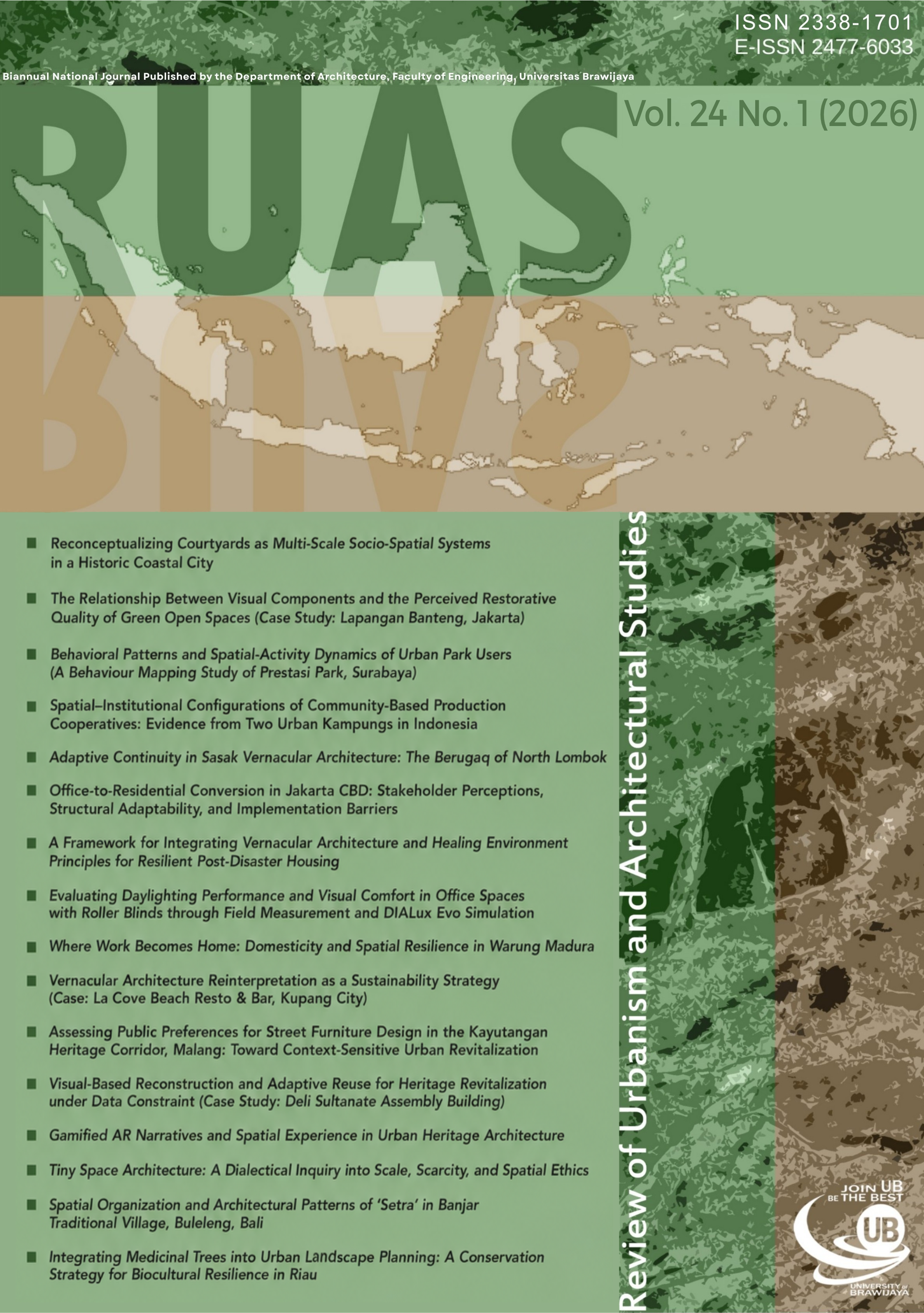
RUAS Journal Volume 24 Number 1 (2026) adopts the theme Human-Centered Built Environments: Heritage, Sustainability, and Spatial Innovation.
This issue presents 16 selected articles written by authors from Indonesia (State University of Malang, Universitas Brawijaya, Udayana University, Institut Teknologi Sepuluh Nopember (ITS), Universitas Atma Jaya Yogyakarta, Calvin Institute of Technology, University of Jember, Telkom University, Universitas Indonesia, Universitas Katolik Widya Mandira, Institut Teknologi Nasional Yogyakarta, Universitas Prima Indonesia, Universitas Sumatera Utara, Universitas Gadjah Mada, and Universitas Riau), China (Sichuan Technology and Business University, and Tsinghua University), and Malaysia (Universiti Sains Malaysia and Universiti Kebangsaan Malaysia).
The published articles examine how architecture and the built environment respond to contemporary societal and environmental challenges through human-centered design, heritage conservation, spatial innovation, and sustainable development. The issue features studies on vernacular architecture, adaptive reuse, digital heritage interpretation, compact living, environmental quality, community-based planning, landscape design, and resilient urban environments. These contributions advance architectural knowledge by integrating theory, empirical research, and design innovation to support more inclusive, culturally responsive, and sustainable built environments. They also demonstrate the growing role of interdisciplinary approaches in addressing the complex relationship between people, place, and the future of the built environment.
DOI: https://doi.org/10.21776/ub.ruas.2026.024.01
Published:
2026-06-30